|
Getting your Trinity Audio player ready...
|
The Short Answer
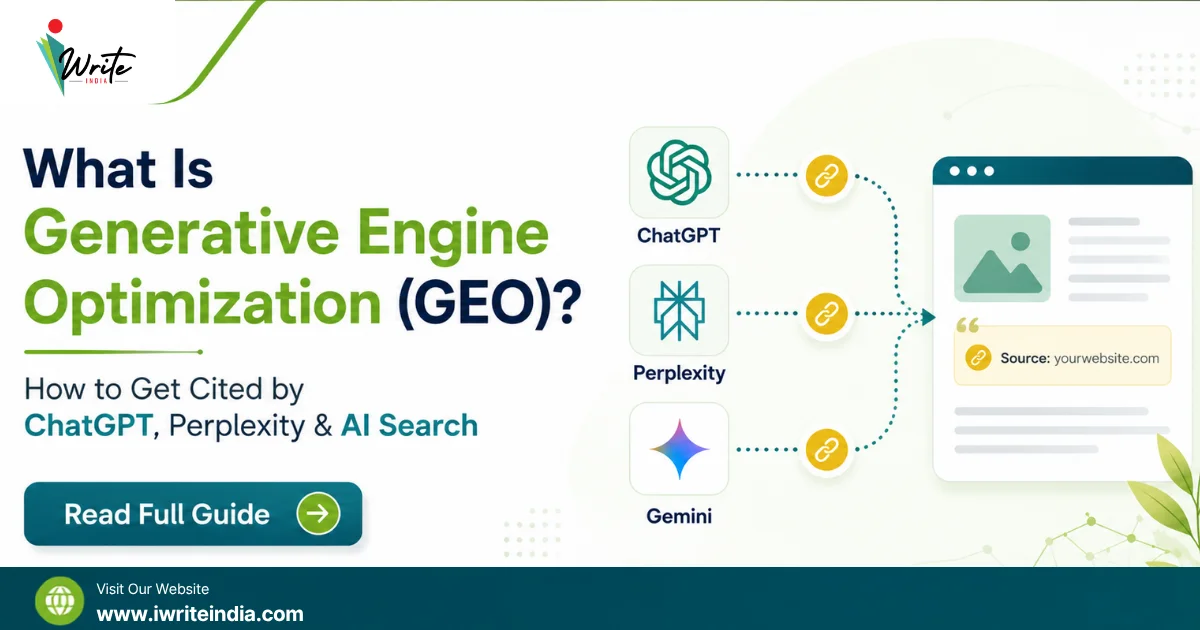
To get cited by ChatGPT, Gemini, and Perplexity: rank well in traditional search (97% of AI citations come from top-20 pages), lead with a direct 40 to 80 word answer after every heading, structure content with clear H2 and H3 headings framed as questions, cite authoritative sources for every specific claim, add named authors with credentials, use schema markup, and publish original data or perspectives that generic AI content cannot replicate.
Introduction
There’s a specific style of writing that gets cited by AI search engines. It’s not clever. It’s not padded with SEO keywords. It doesn’t start with a personal anecdote or a rhetorical question. It leads with the answer, structures the rest around supporting evidence, and cites everything worth citing.
This guide covers the practical framework we use at iWrite India to Optimize Content for AI Search. It’s not theoretical. Every principle here shows up in the content we produce and gets cited across AI Overviews, ChatGPT, and Perplexity for our clients. For the wider picture, our pillar guide on is SEO dead is the piece to read alongside this.
The Foundation: Rank in Traditional Search First
Before any citation-specific optimisation, one thing must be true: your content needs to rank in the top 20 organic results for its target query. Around 97% of AI Overview citations come from pages already ranking in the top 20 traditional positions. If your page isn’t ranking, no amount of AI search optimization changes will get you cited.
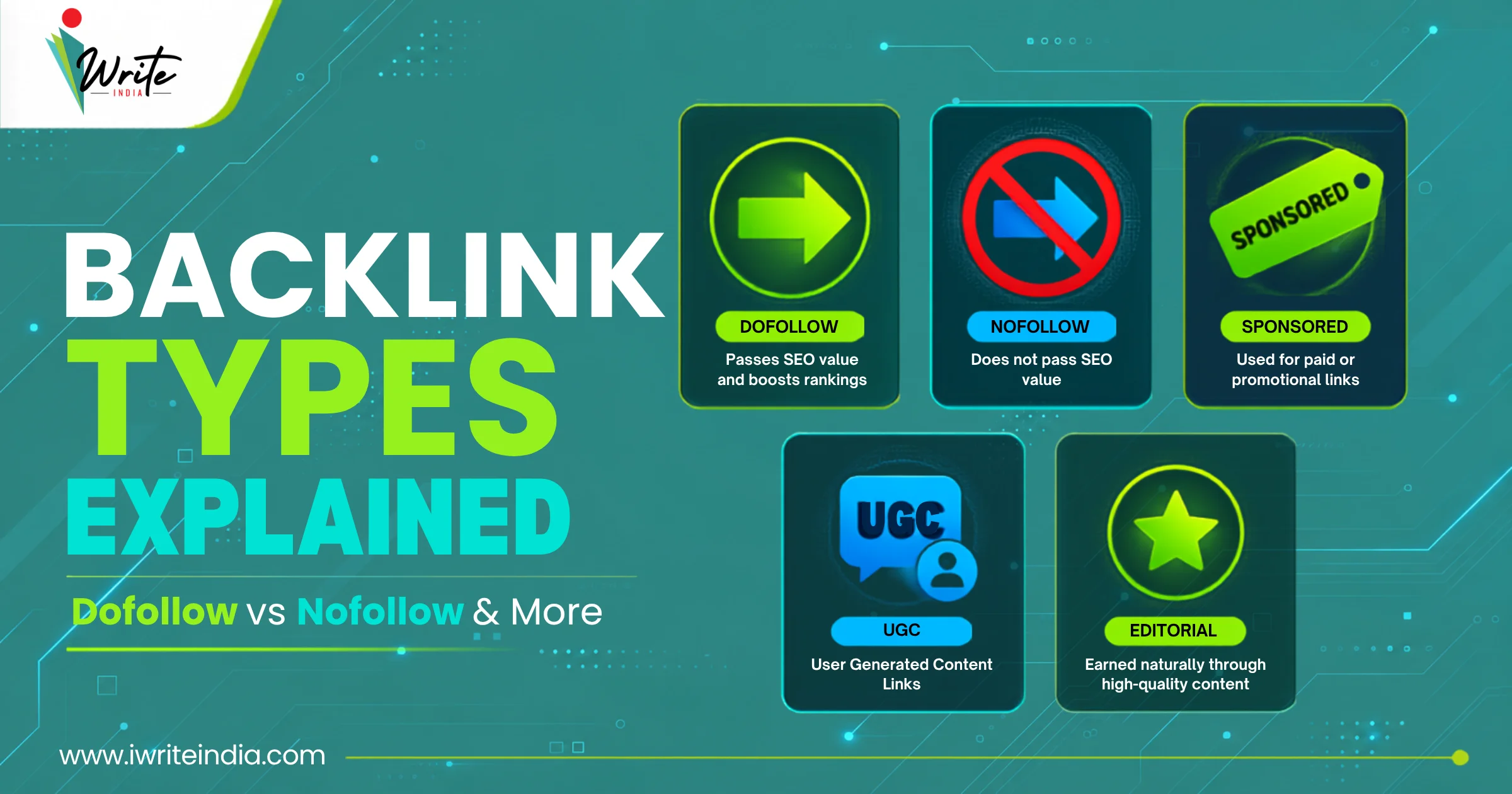
This means traditional SEO fundamentals are the prerequisite: strong on-page SEO, authoritative backlinks, technical health. Our complete on-page SEO guide and complete guide to backlinks in SEO cover the foundations. Everything below is layered on top.
The Six-Part Writing Framework
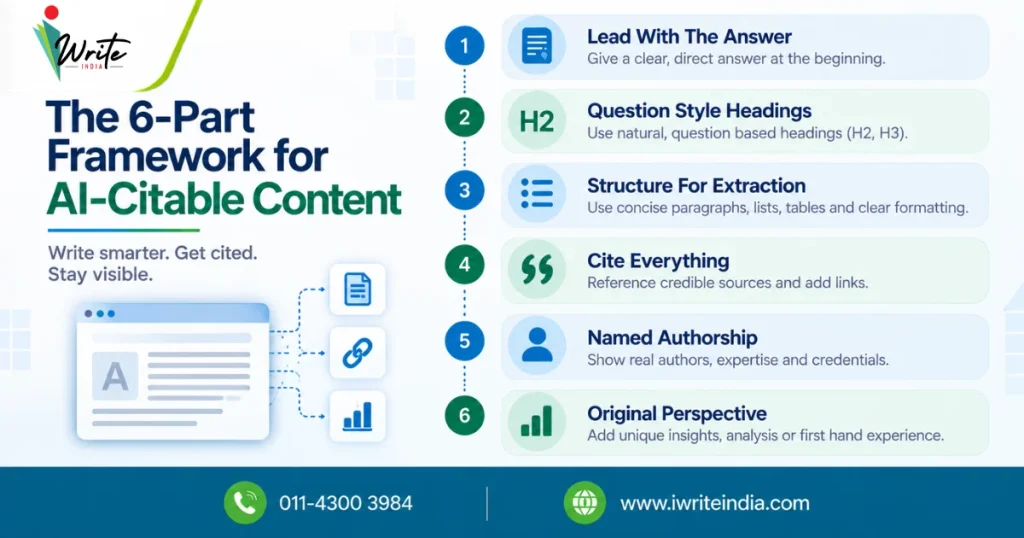
Part 1: Lead With the Answer
Every H2 section should answer the primary question in the first paragraph after the heading. Keep the answer to 40 to 80 words. Make it self-contained: someone reading only that paragraph should get the complete direct answer. This is the format AI systems extract for citations.
Compare two openings for a section titled “What Are Backlinks?”:
Weak: Backlinks are one of the most fundamental concepts in SEO, dating back to Google’s original PageRank algorithm. Understanding them requires…
Strong: Backlinks are hyperlinks from one website that point to another. They act as votes of confidence to Google, signalling that your content is valuable enough to reference.
The second one gets cited. The first one is skipped.
Part 2: Use Question-Style H2 and H3 Headings
Headings framed as questions match how AI systems process queries. “What Is Zero-Click Search?” outperforms “An Introduction to Zero-Click.” Frame at least half your H2 headings as questions where natural.
Part 3: Structure Content for Extraction
Three formats extract cleanly into AI answers:
- Bullet Lists: For enumerable items (steps, factors, examples). AI systems extract these as structured lists.
- Comparison Tables: For direct comparisons (X vs Y). Tables carry high citation weight for comparison queries.
- Clear Definitions: Sentence-first definitions of key terms. AI systems extract these for knowledge-panel-style citations.
Part 4: Cite Authoritative Sources for Every Claim
Every specific statistic, quote, or factual claim needs a source citation. This does two things: signals editorial credibility to Google (E-E-A-T) and gives AI systems confidence to cite you as a downstream source. Content cited by ChatGPT, content cited by Gemini, and content cited by Perplexity all show the same pattern: strong internal citation practice.
Part 5: Named Authors With Verifiable Credentials
Anonymous content struggles to earn citations. AI systems look for entity signals about who created the content. Add a named author with a real bio, professional credentials, and a link to a proper author page. Person schema helps AI systems disambiguate authorship. Our E-E-A-T optimization guide covers the full framework.
Part 6: Publish Original Data or Distinctive Perspectives
AI systems have already absorbed the generic version of every topic. Content that just repeats what’s widely available doesn’t get cited. Original research (even small survey data), first-hand case studies, distinctive expert takes on established topics, or instant answers that resolve edge cases: all of these give AI systems something worth citing.
Expert Insight: Research on What AI Search Engines Cite
Princeton University’s research on generative engine optimisation found that “content with clear citations, direct answers, and structured formatting outperformed keyword-optimised content by 40% in citation frequency across ChatGPT, Perplexity, and Google AI Overviews. Original data and expert perspectives had the strongest single effect.”
Optimising Specifically for Each AI Search Engine
The six-part framework applies across all AI search engines. Some nuances by system for capturing direct answers in Google and beyond:
Google AI Overviews and Gemini
Weight traditional ranking factors most heavily. If you rank top 10 for the query, you’re a strong citation candidate. Schema markup helps. Structure matters. Google’s Gemini model powers both AI Overviews and Google AI Mode; optimising for one lifts both.
ChatGPT Search
Uses Bing as its primary crawl source. Ensure your site is well-indexed by Bing Webmaster Tools. ChatGPT weights recency and clear factual answers, so freshly updated content with clear timestamps performs better.
Perplexity
Places heavy emphasis on citation quality. Perplexity users often want to verify sources, so pages with clearly cited external sources of their own tend to be favoured. Original data particularly performs well here.
Anthropic’s Claude
Fetches web content in real time during browsing. Structure and clear entity signals matter most because Claude processes content contextually. Author authority and E-E-A-T are weighted.
What to Avoid
Some common patterns actively reduce AI citation likelihood:
- Long, Rambling Introductions. AI systems often extract the first paragraph after a heading. Padding kills extraction.
- Overly Clever or Vague Headings. “The Waiting Game” gets skipped; “How Long Does SEO Take?” gets cited.
- Unsourced Claims and Round Numbers. “Studies show that most businesses…” is unhelpful. “Ahrefs’ 2025 analysis of 12.6M queries showed…” gets cited.
- Missing Author or Bio. Anonymous content underperforms named content in citation frequency across all systems.
- Content That Just Restates the Question. If your first paragraph is “Let’s explore what backlinks are” instead of a direct definition, you’ve missed the extraction slot.
How iWrite India Writes for AI Citation
Every blog we produce follows the six-part framework you’re reading now. The AEO Short Answer at the top of every blog is Part 1 in action. The question-style H2 headings are Part 2. The tables and bullet lists are Part 3. The sources section is Part 4. The named author and bio is Part 5. The client examples and original perspective threaded through every article is Part 6.
The result: our clients’ content earns citations across AI Overviews, ChatGPT, and Perplexity at rates well above industry averages. If you want the same framework applied to your existing content, our SEO services in Delhi team can run a citation audit and rewrite programme.
Get a Free AI Citation Audit From iWrite India
If you want to know how often your content is being cited by AI search engines and how to improve the rate, we can help. A free audit shows current citation frequency and provides a rewrite plan.
Book a Free AI Citation Audit today.
Phone: 011-4300 3984
WhatsApp: +91-7303406968
Email: support@iwriteindia.com
Website: www.iwriteindia.com
Office: C-81, Near ICICI Bank, Malviya Nagar, New Delhi 110017
Our USP: Delhi’s trusted SEO partner for 13+ years. Women-led, data-driven, focused on outcomes over trends.
FAQs About Optimize Content for AI Search
Q1. How Do I Write Content That ChatGPT and Perplexity Cite?
Rank in the top 20 traditional search results first (source of 97% of citations). Lead every H2 section with a direct 40 to 80 word answer. Structure content with clear question-style headings, bullet lists, and comparison tables. Cite authoritative sources for every specific claim. Add named authors with credentials. Publish original data or distinctive perspectives.
Q2. What Kind of Content Do AI Search Engines Prefer?
AI search engines prefer content that’s directly answerable, structurally clear, well-sourced, and authored by identifiable experts. They cite content that shows its work (citations to authoritative sources), has entity clarity (named authors, schema markup), and offers something distinct (original data, expert perspectives, first-hand experience). Generic listicles and thin summaries rarely get cited.
Q3. Does Traditional SEO Still Matter for AI Search Visibility?
Yes, critically. Around 97% of AI Overview citations come from pages ranking in the top 20 organic positions. Traditional SEO fundamentals (on-page optimisation, backlinks, technical health) are prerequisites for AI citation. AI search optimisation is a layer on top of traditional SEO, not a replacement for it.
Q4. What’s the Ideal Length for an AI-Citable Paragraph?
40 to 80 words for direct answer paragraphs after each H2 heading. This length aligns with how AI systems extract snippets for citation: long enough to be substantive, short enough to fit cleanly into an AI-generated answer. The AEO Short Answer block at the top of this blog is the format we use across all iWrite India content.
Q5. Should I Use Schema Markup to Get Cited by AI Search?
Yes. Article, FAQPage, HowTo, Person, and Organization schema help AI systems disambiguate entities and understand content structure. WordPress plugins like Rank Math or Yoast handle most schema automatically. Schema alone doesn’t guarantee citation, but it’s a supporting signal that combines with the other framework parts.
Q6. How Long Does It Take to See AI Citation Results After Optimising?
For pages already ranking, structural rewrites can lift citation frequency within 2 to 6 weeks (once AI systems re-crawl and re-evaluate). For pages needing to rank first, the timeline follows traditional SEO: 3 to 6 months to reach top-20 positions in most industries. AI citation is a compounding advantage that builds over time.