
|
Getting your Trinity Audio player ready...
|
Every year in SEO produces a new acronym. This year it’s GEO: generative engine optimization. The term describes what businesses actually need to do to be cited by AI search engines, and it has moved from niche concept to boardroom conversation in under twelve months.
Here’s the useful thing: GEO isn’t a wholesale replacement for SEO. It’s a set of adaptations to how content is written, structured, and supported so that AI systems find it easier to cite. Most of these adaptations also strengthen traditional SEO. That’s the practical opportunity.
This guide covers what GEO is, how it differs from traditional SEO, and the concrete steps to get cited by AI search engines. For the broader picture on 2026 search, our pillar guide on is SEO dead covers the wider landscape.
What Is Generative Engine Optimization?
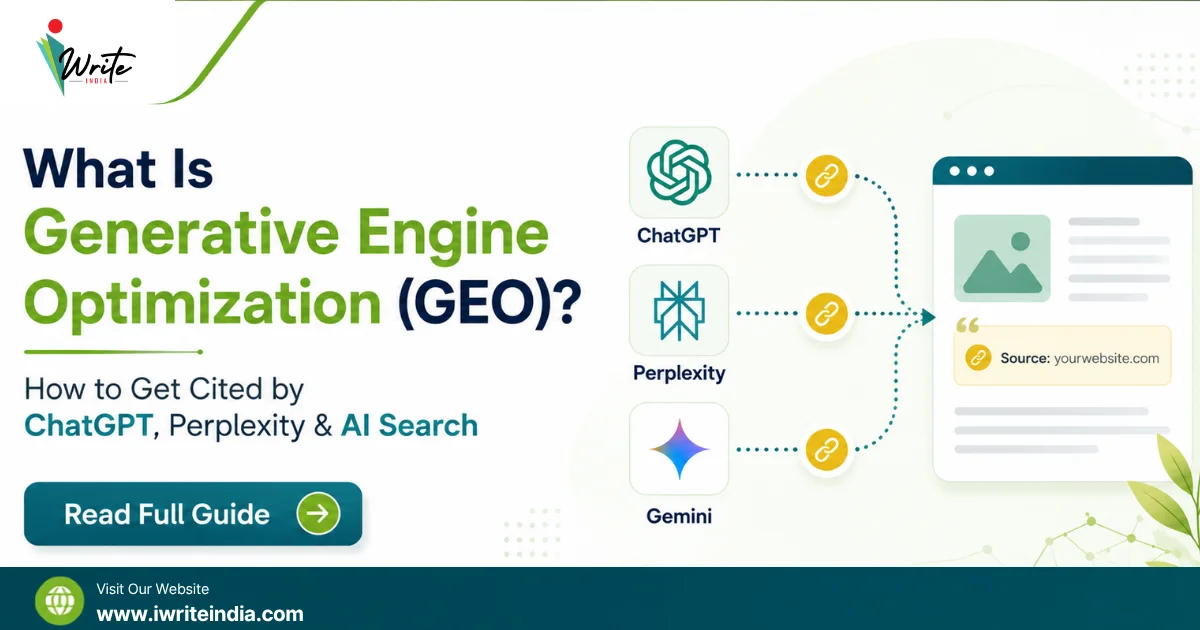
Generative engine optimization is the practice of optimising content so it’s cited, referenced, or summarised by AI-powered search engines and large language models. The systems we’re optimising for include:
- Google AI Overviews (Google’s AI-generated answer boxes)
- Google AI Mode (Google’s full AI search experience)
- ChatGPT search (OpenAI’s AI-powered search)
- Perplexity (AI-first search engine)
- Google Gemini (used across Google products)
- Anthropic’s Claude when browsing
- Microsoft Copilot search
The goal isn’t just visibility in these systems, it’s being cited. When an AI system cites your content in its answer, you gain ai citations that drive brand awareness, referral traffic, and downstream authority.
GEO vs SEO: How They Differ and Overlap

The geo vs seo comparison isn’t binary. GEO builds on SEO. Here’s how they compare:
| Dimension | Traditional SEO | GEO |
|---|---|---|
| Primary Goal | Rank in Google search results | Get cited in AI-generated answers |
| Success Metric | Rankings, CTR, organic sessions | Citation frequency, AI-referred traffic, brand mentions in AI answers |
| Content Style | Keyword-rich, comprehensive | Direct answers, citable claims, structured facts |
| Formatting Focus | Readability + SEO signals | Snippet-ready structure, definitions, tables |
| Source Requirements | Trust for E-E-A-T | Explicit citations of authoritative sources |
| Foundation Required | Traditional SEO fundamentals | Traditional SEO plus GEO adaptations |
AI Search Ranking Factors: What Actually Drives Citations
Research from Princeton and other groups analysing ai search ranking factors has identified consistent patterns in what gets cited. The five most important factors:
Factor 1: Traditional Search Rankings
Around 97% of AI Overview citations come from pages ranking in the top 20 organic results. This is the single strongest predictor. If your page doesn’t rank in traditional search, it won’t be cited in AI search either.
Factor 2: Direct, Extractable Answers
AI systems favour content where the answer to a specific question appears clearly, ideally within the first paragraph after a relevant heading. The AEO answer block format we use across iWrite India blogs is designed for exactly this.
Factor 3: Authoritative Citations
AI systems weight content that cites its own sources heavily. A page with clear citations to peer-reviewed research, official documentation, or authoritative publications gets cited more often than a page making the same claims without citations.
Factor 4: Entity Clarity
AI systems read entities: your business, services, location, team, industry. Content with clear entity signals (structured data, consistent naming, About pages with detail) gets identified as an authority on those entities.
Factor 5: E-E-A-T Signals
Experience, Expertise, Authority, Trustworthiness. Named authors, real credentials, editorial oversight, and transparent processes all lift citation likelihood. Our E-E-A-T optimization guide covers this in depth.
Expert Insight: Research on What AI Systems Cite
A Princeton University study analysing GEO effectiveness across multiple AI systems found that “citation-rich content with clear entity signals and authoritative sourcing outperformed traditional keyword-optimised content by 40% in citation frequency across ChatGPT, Perplexity, and Google AI Overviews”.
How to Optimise for ChatGPT, Perplexity, and Gemini
Each AI search system weights signals slightly differently, but the practical steps to optimize for chatgpt, optimize for perplexity, and optimize for gemini overlap heavily. The core geo strategy for business:
Lead With Direct Answers
Answer the primary question in the first paragraph after each H2. Keep the answer to 40 to 80 words, factual, and self-contained. This mirrors how AI systems extract snippets for citation.
Structure Content for Extraction
Use clear H2 and H3 headings framed as questions. Include bullet lists for enumerable items. Use tables for comparisons. All three formats extract cleanly into AI answers.
Cite Everything You Claim
Every specific statistic, quote, or factual claim should reference its source explicitly. AI systems favour content that shows its work over content that asserts without support.
Add Author Attribution
Named authors with credentials and bio links. AI systems reading a page look for entity signals about who created it. Anonymous content gets cited less often.
Use Schema Markup
Article, FAQPage, Person, and Organization schema help AI systems disambiguate entities. Rank Math or Yoast plugins handle most of this automatically for WordPress sites.
Publish Original Data or Perspectives
AI systems avoid citing content that just repeats what’s already widely available. Original research, primary data, or distinctive expert perspectives get llm optimization advantage. Aim to be citable, not just present.
How iWrite India Approaches GEO for Clients
Our position across every 2026 engagement is direct. GEO isn’t a separate service; it’s built into how we approach content strategy from the start. Every article we produce uses the answer-first format, clear structured headings, cited sources, named authors, and schema markup as standard. It’s the same reason our approach to content also strengthens traditional SEO.
For an ecommerce client like Circles & Squares, this meant reformatting existing product content to answer specific buying questions clearly and adding structured data for products. For a client like Synergy Rehab, it meant strengthening author bios and adding evidence-based citations across their content library. Different industries, same GEO principles.
If you’d like a GEO audit alongside your traditional SEO audit, our SEO services in Delhi team runs both together, or contact our SEO Agency in Delhi for a combined review.

Get a Free GEO Audit From iWrite India
If you want to know where you stand in AI search citation frequency and what to do about it, we can help. A free GEO audit shows how often you’re being cited and provides an action list.
Book a Free GEO Audit today.
WhatsApp: +91-7303406968
Email: [email protected]
Website: www.iwriteindia.com
Office: C-81, Near ICICI Bank, Malviya Nagar, New Delhi 110017
Our USP: Delhi’s trusted SEO partner for 13+ years. Women-led, data-driven, focused on outcomes over trends.
FAQs About Generative Engine Optimization
Q1. What Is Generative Engine Optimization (GEO)?
Generative Engine Optimization (GEO) is the practice of optimising content so it’s cited or referenced by AI-powered search engines like Google AI Overviews, ChatGPT, Perplexity, and Gemini. GEO builds on traditional SEO with additional focus on direct answers, citation-friendly formatting, entity clarity, and authoritative sourcing.
Q2. What’s the Difference Between GEO and SEO?
SEO optimises for ranking in traditional Google search results; GEO optimises for being cited in AI-generated answers. They overlap significantly in content quality, structured data, and E-E-A-T signals. GEO isn’t a replacement for SEO; it’s an overlay. Around 97% of AI citations come from pages already ranking in the top 20 organic results, so SEO is the prerequisite.
Q3. How Do I Get Cited by ChatGPT and Perplexity?
Rank well in traditional search, structure content for extraction (clear headings, direct answers, tables, lists), cite authoritative sources, add named authors with credentials, use schema markup (Article, FAQPage, Person, Organization), and publish original data or distinctive perspectives. AI systems favour citable content over generic content.
Q4. What Are the Main AI Search Ranking Factors in 2026?
Five main factors: traditional search rankings (strongest single predictor), direct extractable answers, authoritative citations within your content, entity clarity through structured data and consistent naming, and E-E-A-T signals like named authors and editorial oversight. Content quality remains the underlying foundation.
Q5. Do I Need a Separate GEO Strategy or Can It Sit Within SEO?
GEO can and should sit within your broader SEO strategy in 2026, not as a separate initiative. Most GEO best practices strengthen traditional SEO too. The main additions are direct-answer formatting, tighter citation practices, and more attention to entity clarity. These add cost measured in hours per piece, not a separate budget line.
Q6. Which AI Search Engines Should I Optimise For?
In order of current importance in India: Google AI Overviews (integrated into Google Search), ChatGPT search, Perplexity, and Google Gemini. Optimising for one generally lifts visibility across all four because the underlying signals overlap. Focus on the fundamentals rather than trying to game any single system.