|
Getting your Trinity Audio player ready...
|
Somewhere in the last eighteen months, most SEO teams in Delhi and across India noticed something odd in their analytics. Rankings hadn’t dropped. Impressions were often up. But clicks were down. Sometimes sharply.
The culprit is Google AI Overviews, the AI-generated answer boxes that now sit above traditional organic results on a growing share of Google queries. This guide covers the real impact data, what causes the traffic loss, and the practical adaptation strategy that works. For the wider picture, our pillar guide on is SEO dead is the piece to read alongside this.
What Are Google AI Overviews?
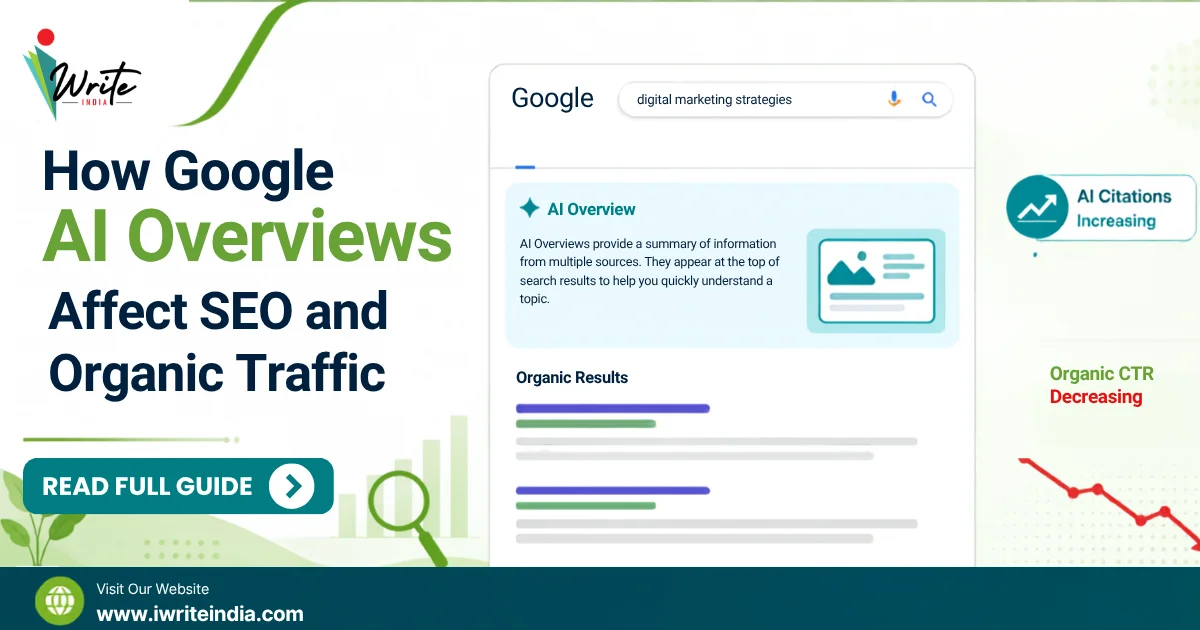
Google AI Overviews are AI-generated summary answers that appear at the top of Google search results for many queries. Powered by Google Gemini, they synthesise information from multiple web sources and present a direct answer to the user’s question, with citations to the sources they drew from.
The visual result: the user often gets what they need without scrolling. Traditional organic listings appear below the AI Overview, but many users never see them. This is the mechanism behind zero-click searches for informational queries.
The Real Impact on Organic Traffic and CTR

CTR Drops Are Real and Significant
Seer Interactive’s analysis of 5.47 million queries across 53 brands found ai overviews ctr drop of around 65% on queries where AI Overviews appear (from 1.76% to 0.61%). The impact concentrates in informational and educational queries, where AI Overviews are most likely to appear.
Zero-Click Rates Have Climbed
Similarweb data shows zero-click searches rose from 56% in May 2024 to around 69% in mid-2025, with mobile zero-click reaching 77%. In Google AI Mode specifically, the zero-click rate is around 93%. Users who would previously have clicked through are getting their answers directly from the AI summary.
Publisher Traffic Has Dropped Sharply
Chartbeat data via the Reuters Institute reported publisher traffic falling around 33% globally and 38% in the US year-over-year. ai overviews traffic loss has been most pronounced in categories dominated by informational queries: health, education, definitions, how-to content.
But Cited Brands Are Winning
The countervailing finding from Seer Interactive: brands whose content is cited within AI Overviews earn around 35% more organic clicks and 91% more paid clicks than uncited brands. Being cited by AI has become a distinct visibility layer with real commercial value.
Expert Insight: Google’s Statement on AI Overview Traffic
Google Search Central states that “AI Overviews continue to send more clicks to the web than legacy features they replaced, though the exact impact varies by query type and industry”.
Independent measurement disputes this framing for many verticals, particularly informational and publisher-focused sites, where measured traffic declines have been substantial.
Which Queries Trigger AI Overviews
AI Overviews don’t appear on every query. Understanding which queries trigger AI answers in Google Search helps you plan where to expect impact:
- High Trigger. Informational queries (what is, how to, why does), definitional queries, health and medical questions, technical explanations.
- Medium Trigger. Comparison queries (X vs Y), recommendations (best X for Y), some commercial-intent queries.
- Low Trigger. Highly transactional queries (buy X near me), branded searches, ecommerce product-specific searches.
- Almost Never. Navigational queries (specific website names), high-uncertainty queries where Google isn’t confident enough to summarise.
The Three-Part Adaptation Strategy
Businesses that adapt well to generative AI in search follow a three-part response:
Part 1: Get Cited in AI Overviews
Since cited brands earn substantially more clicks, citation is the highest-value adaptation. This means content structured for extraction (clear headings, direct answers, tables), authoritative sourcing, named authors, and E-E-A-T signals. Our how to write content ChatGPT, Gemini, and Perplexity cite guide covers the practical framework.
Part 2: Diversify Traffic Sources
If organic traffic from informational queries is under pressure, invest in channels less affected by AI Overviews: branded search, direct traffic, email, LinkedIn organic, referral partnerships, YouTube, and paid search. The businesses least affected by AI Overviews in 2026 have the most diverse traffic profiles.
Part 3: Shift Content Focus to Commercial Intent
Commercial-intent queries (compare, best, alternatives to, buy) trigger AI Overviews less often and convert better when they do click. Reallocate content investment from informational listicles toward commercial-intent guides. This is where the traffic that remains valuable actually lives.
How AI Overviews Interact With Other SEO Elements
Featured Snippets. AI Overviews often replace what would have been a Featured Snippets position. The zero-click behaviour is now baked in more thoroughly.
Helpful Content System. Google’s Helpful Content System, now integrated into the core algorithm as of December 2025, weights quality signals that also predict AI Overview citation.
Core Web Vitals. Core Web Vitals affect rankings, which affect AI Overview citation eligibility. Poor page performance can reduce citation frequency indirectly.
Google Knowledge Graph. Well-defined entity presence in the Google Knowledge Graph strengthens AI Overview trust signals for your brand.
Google Gemini. Google Gemini is the model powering AI Overviews. Understanding how Gemini processes and cites sources helps calibrate content strategy.
How iWrite India Helps Clients Adapt
Every audit we run in 2026 includes an AI Overview impact assessment: which of your queries trigger Overviews, whether you’re cited, what your citation share of voice looks like, and where the biggest recovery or growth opportunities sit.
For an ecommerce client like Circles & Squares, this meant identifying that commercial-intent product queries were largely unaffected while informational blog traffic had declined. The response: hold the commercial content, restructure informational content for citation eligibility, and invest more in commercial-intent guides.
For a service business, the response might look different. Our SEO services in Delhi team runs the assessment and builds an adaptation plan tailored to how your traffic is actually distributed.

Get a Free AI Overview Impact Audit From iWrite India
If you’re seeing traffic changes and want to understand exactly what AI Overviews are doing to your visibility, we can help. A free audit shows the impact and the adaptation plan.
Book a Free AI Overview Impact Audit today.
Phone: 011-4300 3984
WhatsApp: +91-7303406968
Email: [email protected]
Website: www.iwriteindia.com
Office: C-81, Near ICICI Bank, Malviya Nagar, New Delhi 110017
Our USP: Delhi’s trusted SEO partner for 13+ years. Women-led, data-driven, focused on outcomes over trends.
FAQs About Google AI Overviews
Q1. What Are Google AI Overviews?
Google AI Overviews are AI-generated answer boxes that appear at the top of Google search results for many queries. Powered by Google Gemini, they synthesise information from multiple web sources and present a direct answer with citations. They cover around 13% of Google queries in mid-2026, projected to reach 20 to 25% by year-end.
Q2. How Much Have AI Overviews Reduced Organic Traffic?
Seer Interactive’s analysis of 5.47 million queries showed CTR dropping around 65% (from 1.76% to 0.61%) on queries where AI Overviews appear. Publisher traffic globally has fallen around 33% (38% in the US) year-over-year per Chartbeat. Individual sites vary; informational categories are hit hardest, commercial-intent categories less so.
Q3. Which Queries Trigger AI Overviews?
High trigger: informational queries (what is, how to, why does), definitional queries, health and medical questions. Medium trigger: comparison and recommendation queries. Low trigger: highly transactional queries, branded searches, ecommerce product-specific searches. Navigational queries almost never trigger AI Overviews.
Q4. Can I Opt My Website Out of AI Overviews?
Not comprehensively for AI Overviews specifically. Google’s AI Overviews use Google’s regular web index, so blocking Google would also block Search. You can use the nosnippet meta tag to prevent content extraction into snippets, but this also affects featured snippets and can reduce visibility. Most experts advise adapting rather than opting out.
Q5. Do AI Overviews Help or Hurt My Brand?
Both, depending on whether you’re cited. Brands cited in AI Overviews earn around 35% more organic clicks and 91% more paid clicks than uncited brands (Seer Interactive). Uncited brands lose traffic to zero-click behaviour. The adaptation strategy: focus on being cited rather than fighting the format.
Q6. How Do I Get My Content Cited in AI Overviews?
Rank in the top 20 organic results (around 97% of citations come from these positions), structure content for extraction with clear headings and direct answers, cite authoritative sources within your content, add named authors with credentials, use schema markup, and publish original data or distinctive perspectives. Most GEO best practices lift AI Overview citation frequency.