|
Getting your Trinity Audio player ready...
|
The Short Answer
Zero-click search is when a user’s query is answered directly on the search results page without them clicking through to any website. Around 60% of Google searches now end without a click, rising to 77% on mobile and 93% in Google AI Mode. Zero-click searches affect website traffic by absorbing informational queries. Adaptation: get cited in answer boxes, focus on commercial-intent traffic, and diversify beyond organic search.
Introduction
A user searches “what time does the Eiffel Tower close.” Google shows the answer directly at the top of the results page. The user never clicks a link. That’s zero-click search, and it now describes the majority of Google search behaviour.
The trend has been building since 2016, when Google started expanding answer boxes and knowledge panels. In 2024 and 2025, AI Overviews accelerated it dramatically. By mid-2026, around 60% of Google searches end without any click. On mobile the number is 77%. In Google AI Mode, it’s around 93%.
This guide covers what zero-click search actually is, the impact on organic traffic, and how businesses should adapt. For the wider picture on AI’s effect on SEO, our pillar guide on is SEO dead is the piece to read alongside this.
What Is Zero-Click Search?
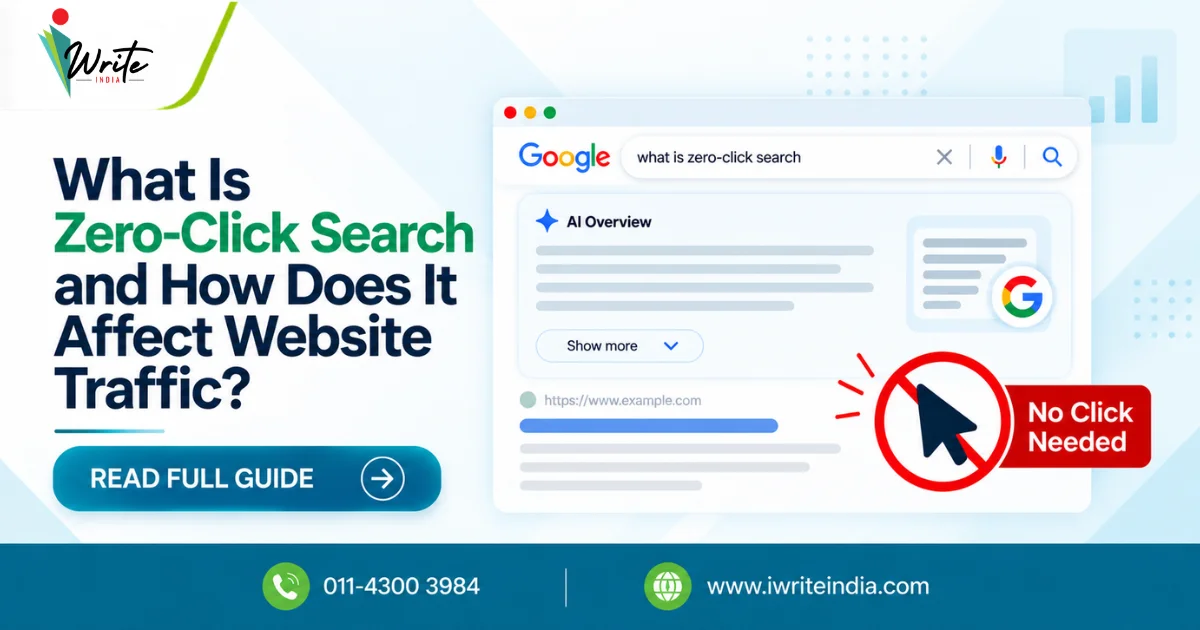
Zero-click search refers to any search query that ends without the user clicking through to a website from the search results page. The answer is delivered directly on the results page itself, so the user’s need is satisfied without leaving Google.
Sources of Google zero-click results include:
- AI Overviews (Google’s AI-generated answer boxes)
- Featured Snippets (extracted text from a webpage)
- Knowledge Panels (from Google’s Knowledge Graph)
- Direct Answers (“what time is it in Delhi” returning the time)
- People Also Ask boxes (answers expand inline)
- Local pack results (map + business info without a click)
- Weather widgets, currency converters, calculators
Why Zero-Click Search Has Grown So Much
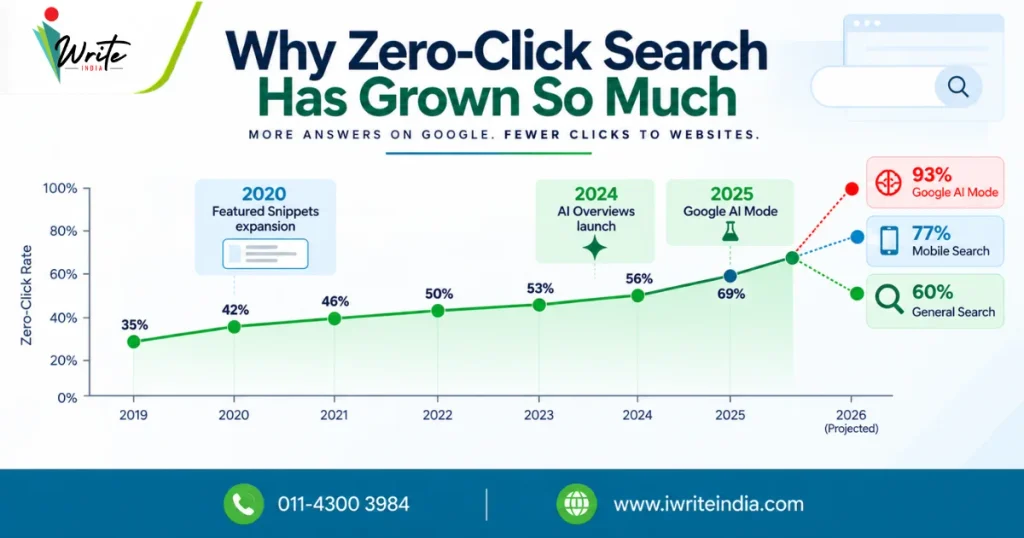
The growth in zero-click behaviour has three main drivers:
Google Wants Users to Stay on Google
Every element that keeps users on the Google search results page (knowledge panels, direct answers, AI Overviews) is also a way for Google to keep the user engaged with Google-owned surfaces. This is aligned commercial incentive, not conspiracy.
Users Have Adapted to Faster Answers
Once users learn that Google can answer simple questions directly, they stop clicking. Behaviour changes durably. This is why AI Overviews have driven a broader CTR decline even on queries where they don’t appear.
AI Search Accelerated Everything
Google AI Overviews (2024 launch) and Google AI Mode (2025) provide AI-generated answers that cover far more question types than featured snippets ever did. This is what pushed zero-click from a majority-behaviour to a dominant-behaviour pattern.
The Impact on Organic Website Traffic
The consequences of no-click search results for website traffic are concentrated but real:
Informational Traffic Has Fallen Sharply
Publisher traffic globally fell around 33% year-over-year, per Chartbeat / Reuters Institute data. Sites earning traffic from “what is,” “how to,” and definition-style queries have seen the largest declines. Some categories (health information, definitions, basic tutorials) have been hit worst.
But Commercial-Intent Traffic Is Less Affected
Queries with clear commercial intent (“best SEO agency in Delhi,” “compare X vs Y,” “buy Y online”) continue to drive clicks because users need to make decisions. AI answers help narrow the choice, but the final action still requires visiting sites. This is where organic search visibility retains real value.
Brand-Recognised Businesses Do Better
Branded queries (“iWrite India services,” “Circles & Squares reviews”) show higher CTR because users specifically want that brand’s own site. In the AI-search era, brand recognition compounds SEO effort.
Expert Insight: Similarweb on Zero-Click Trends
Similarweb data shows zero-click searches rose from 56% in May 2024 to around 69% in mid-2025, with mobile zero-click reaching 77%. Their commentary noted the rise correlated closely with AI Overview expansion and continued Google feature rollout, and represents a durable behaviour change rather than a temporary shift.
What Businesses Should Do About Zero-Click Search
There’s no way to reverse zero-click growth. There is a practical adaptation framework. Every business should consider these three responses to zero-click SERPs:
Response 1: Get Featured in the Answer Boxes
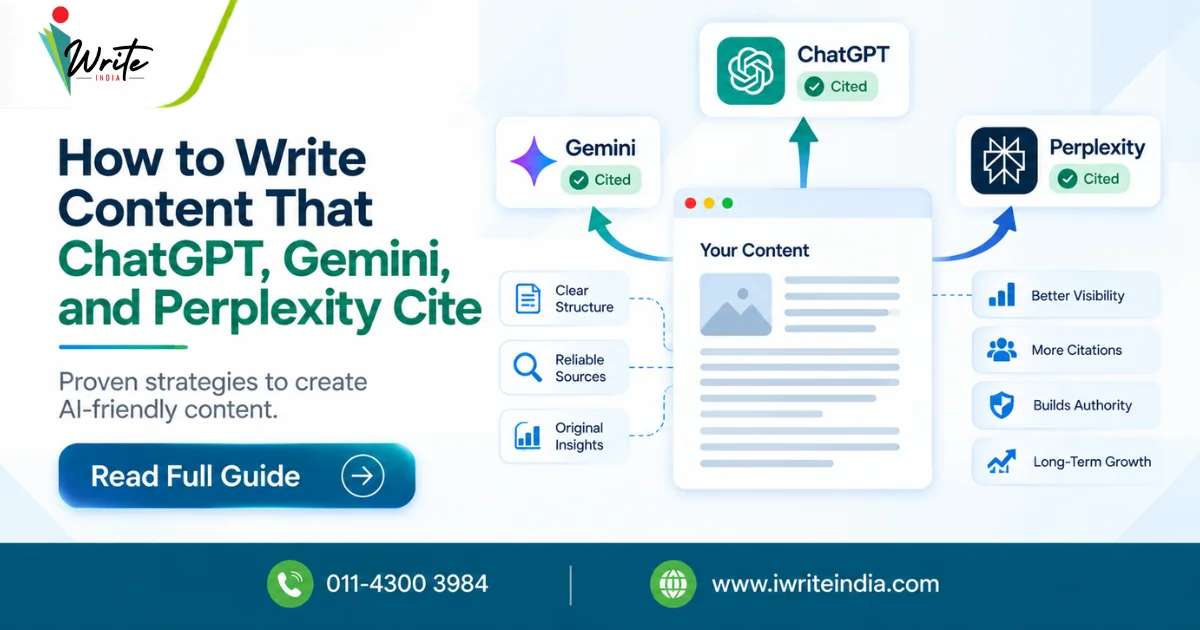
Featured snippets, AI Overviews, and People Also Ask boxes all cite sources. Being cited generates brand visibility even without a click, and cited brands earn substantially more clicks on the queries where clicks do happen. Structure content for extraction, use answer-first paragraphs, add schema markup. Our how to write content ChatGPT, Gemini, and Perplexity cite guide covers the framework.
Response 2: Focus on Commercial and Branded Search
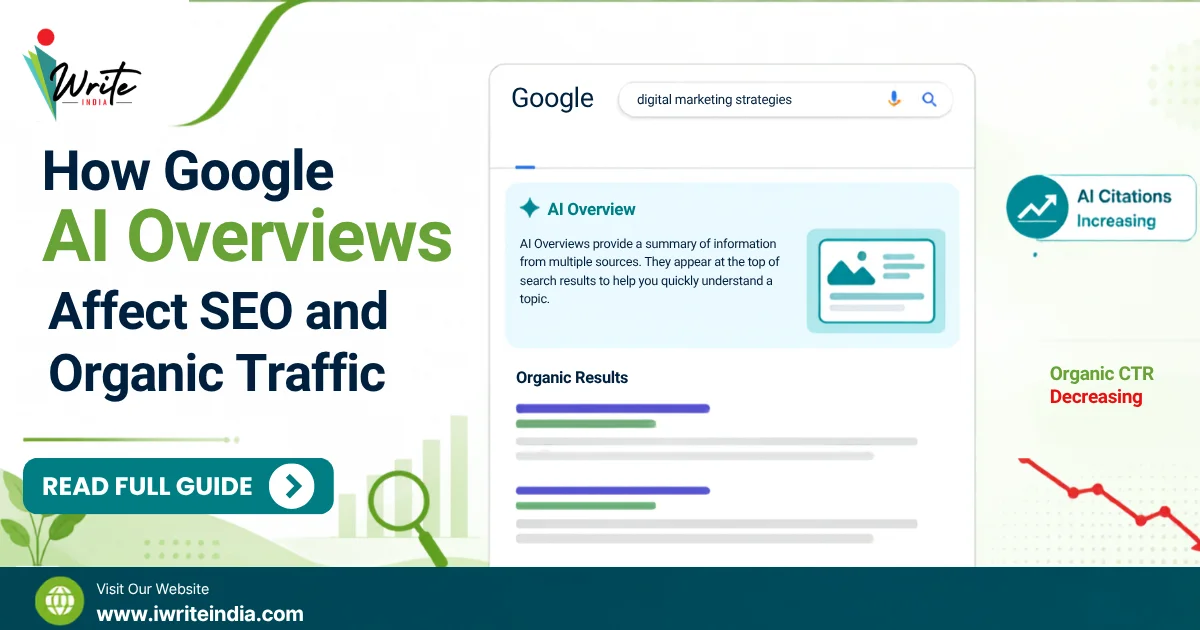
If informational queries are absorbed by zero-click, shift content investment toward commercial-intent queries. “Best,” “compare,” “vs,” “alternatives to,” “pricing,” “reviews.” These queries still generate clicks because they require decisions. Read our guide on how Google AI Overviews affect SEO for the detailed strategy.
Response 3: Diversify Traffic Sources
If organic search delivers fewer clicks than it used to, invest in channels less affected: email marketing, LinkedIn organic, referral partnerships, YouTube, direct traffic through brand-building, and paid search. Sites least affected by zero-click search in 2026 have the most diverse traffic profiles.
Measuring Zero-Click Impact on Your Own Site
Zero-click search impact isn’t visible in one number. It shows up in a specific pattern:
- Impressions stable or rising, but clicks falling (Google Search Console)
- Average position stable or improving, but organic sessions declining
- Higher share of “branded” and “navigational” traffic within remaining clicks
- Informational blog traffic declining faster than commercial page traffic
If your Search Console shows this pattern, zero-click search is the likely cause. The response is adaptation, not panic. For a diagnostic, our SEO services in Delhi team can run a full traffic-source assessment.
How iWrite India Approaches Zero-Click Adaptation
Every audit we run in 2026 includes a zero-click impact assessment. We look at what share of your target queries are affected by AI-powered search features, where you’re already being cited, and where the biggest recovery opportunities live.
For an ecommerce client like Circles & Squares, we found commercial-intent queries were largely intact while informational blog traffic had declined 40%. The response was to restructure the informational content for AI citation eligibility and add more commercial-intent guides. The overall result was mixed traffic recovery plus a lift in qualified sessions.
For a service business, the adaptation pattern would be different. Every zero-click response depends on how your specific traffic is currently distributed.
Get a Free Traffic Diversification Audit From iWrite India
If your organic clicks are falling while impressions stay steady, zero-click search is the likely cause. A free audit shows exactly what’s happening and what to do about it.
Book a Free Traffic Diversification Audit today.
Phone: 011-4300 3984
WhatsApp: +91-7303406968
Email: support@iwriteindia.com
Website: www.iwriteindia.com
Office: C-81, Near ICICI Bank, Malviya Nagar, New Delhi 110017
Our USP: Delhi’s trusted SEO partner for 13+ years. Women-led, data-driven, focused on outcomes over trends.
FAQs About Zero-Click Search
Q1. What Is Zero-Click Search?
Zero-click search is any Google search that ends without the user clicking through to a website. The answer is delivered directly on the search results page through features like AI Overviews, Featured Snippets, Knowledge Panels, direct answers, People Also Ask boxes, or local pack results. Around 60% of Google searches now end without a click in mid-2026.
Q2. How Much of Google Search Is Zero-Click in 2026?
Around 60% of Google searches overall end without a click. Mobile is higher at 77% (per Similarweb). Google AI Mode has the highest zero-click rate at around 93%. The trend has grown steadily since 2016 and accelerated sharply after Google AI Overviews launched in 2024.
Q3. What Causes Zero-Click Search Behaviour?
Three main drivers: Google’s expansion of on-SERP answer features (AI Overviews, Featured Snippets, Knowledge Panels), user adaptation to faster answers once they learn Google can respond directly, and the launch of Google AI Overviews (2024) and Google AI Mode (2025), which cover far more question types than earlier features.
Q4. How Does Zero-Click Search Affect Website Traffic?
Informational query traffic falls sharply. Publisher traffic globally dropped around 33% year-over-year (Chartbeat / Reuters Institute). Commercial-intent traffic is less affected because users still need to visit sites to make decisions. Brand-recognised businesses maintain higher CTR than unknown competitors. Overall, the impact varies dramatically by industry and content mix.
Q5. Can I Recover Traffic Lost to Zero-Click Search?
Some, yes. Get your content cited in answer boxes and AI Overviews (cited brands earn around 35% more organic clicks). Shift content investment toward commercial-intent queries that still drive clicks. Diversify traffic sources beyond organic search. Full recovery of pre-zero-click traffic levels is unlikely; adaptation is the sustainable response.
Q6. How Do I Get My Content Featured in Zero-Click Answer Boxes?
Structure content for extraction: clear H2 and H3 headings framed as questions, direct 40 to 80 word answer paragraphs immediately after each heading, tables and bullet lists for enumerable items, schema markup (Article, FAQPage), and authoritative citations within the content. AEO and GEO frameworks address exactly this optimisation.