|
Getting your Trinity Audio player ready...
|
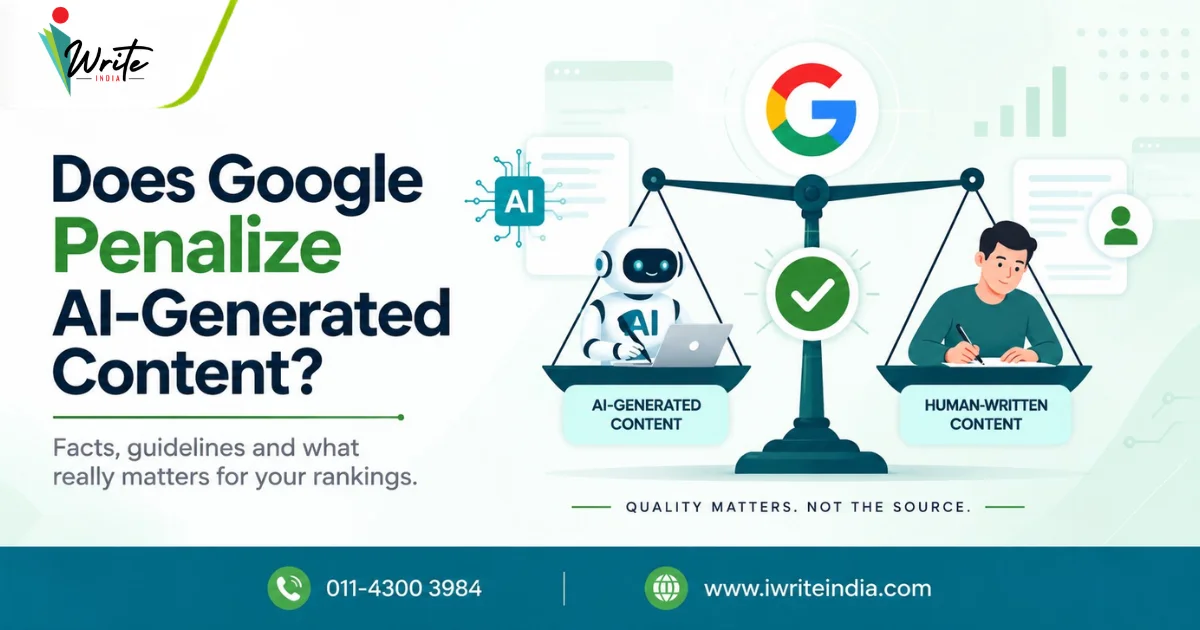
No, Google does not penalise AI-generated content simply for being AI-generated. Google’s official policy is origin-agnostic: content is judged on quality, helpfulness, and value, not on the tool used to create it. However, Google does penalise unhelpful, mass-produced, low-quality content, and AI-assisted content is disproportionately affected because it’s often exactly that kind of content.
Introduction
The February and March 2026 Google core updates hit a lot of sites hard. Traffic drops of 40 to 60% became common across AI-content-heavy sites. Panic spread. Consultants declared Google was finally penalising AI content.
The reality is more precise. Google didn’t penalise AI content. It penalised unhelpful content, and unhelpful content just happens to be what most mass-produced AI publishing looks like. The difference matters because it changes what businesses should actually do about AI content SEO.
This guide covers Google’s actual policy, what genuinely triggers penalties in 2026, and how to use AI safely in content production. For the wider AI + SEO picture, our pillar guide on is SEO dead is the piece to read alongside this.
What Google Officially Says About AI Content
Google’s Google AI content policy is remarkably consistent. Since February 2023, Google has stated that content quality is judged on helpfulness and reliability, not on whether a human or machine produced it. From Google Search Central: “Our focus on the quality of content, rather than how content is produced, is a useful guiding principle.”
The 2023 position hasn’t changed through 2024, 2025, or 2026. What has changed is Google’s enforcement sophistication. The December 2025 core update integrated the Helpful Content System into the core ranking algorithm, and the February and March 2026 updates continued the trend of targeting low-quality patterns rather than AI adoption itself.
What Actually Triggers Google Penalties in 2026
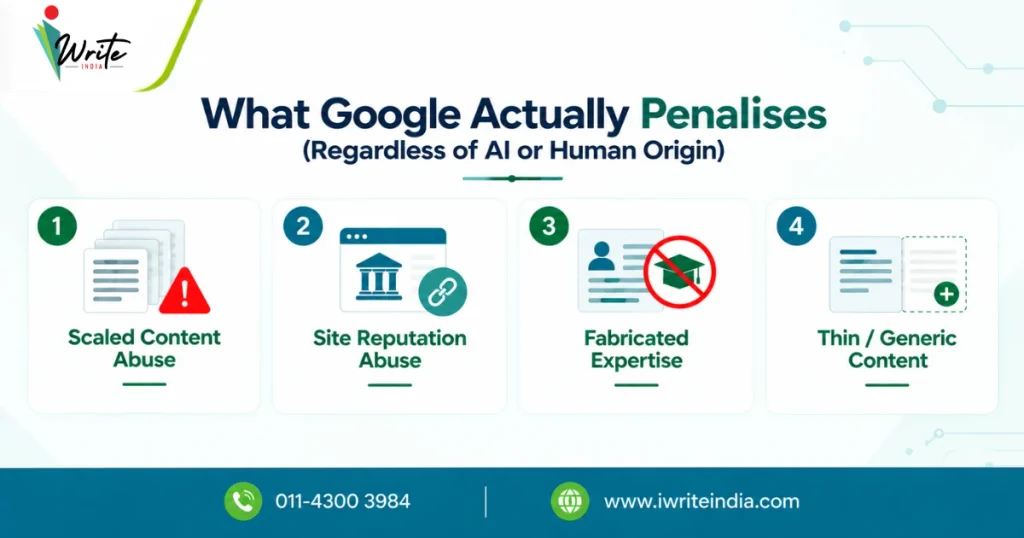
Design brief: Titled ‘What Google Actually Penalises (Regardless of AI or Human Origin)’. Grid of four large panels: 1. Scaled Content Abuse (mass production for ranking), 2. Site Reputation Abuse (parasite SEO on authoritative domains), 3. Fabricated Expertise (claims without support), 4. Thin/Generic Content (no distinct value). Each panel has a red warning icon and one-line description. On-brand Royal Blue with red accents. Mobile-legible. Shareable format.
Google’s actual penalty framework targets four categories, all of which apply to human and Google AI-generated content equally:
Category 1: Scaled Content Abuse
Producing many pages primarily to manipulate search rankings, regardless of whether they’re written by AI or humans. This is Google’s most-cited target. A 4,000-word AI post full of generic advice and a 4,000-word human post with the same problem get treated identically.
Category 2: Fabricated Expertise
Claims of expertise and authority that aren’t supported: fake author bios, invented credentials, review content from authors who never used the product. Google’s Helpful Content System looks for verifiable expertise signals.
Category 3: Site Reputation Abuse
Publishing low-quality content on authoritative domains (sometimes called parasite SEO) to piggyback on the domain’s trust. Google addressed this specifically in the 2024 policy updates.
Category 4: Thin or Generic Content
Content that adds no distinct value beyond what’s already available. Repetitive listicles, definition regurgitation, and “how to” posts that summarise what everyone else has said. AI content at scale tends to look exactly like this because that’s what generic prompts produce. This is where AI content and Google rankings concerns actually apply.
Expert Insight: Google’s Direct Position on AI Content
Google Search Central states: “Rewarding high-quality content, however it is produced, has been a core part of our approach for many years. Rather than focusing on how content is created, our systems continue to focus on the quality of content.”
The December 2025 core update, which integrated the Helpful Content System into core ranking, was described by Google as targeting quality signals rather than AI authorship.
Source: Google Search Central Documentation and Blog, 2023-2026.
Why Mass AI Content Gets Hit Anyway
Even though Google’s policy is origin-agnostic, sites publishing AI-written content at scale have been disproportionately affected by recent updates. This isn’t a contradiction; it’s a pattern-recognition issue.
AI content at scale tends to exhibit exactly the patterns Google’s quality systems target:
- Generic advice without specific expertise or first-hand experience
- Unverifiable claims presented without citations
- Repetitive structure that reads similar to other AI-generated content
- High output volume with limited distinguishing value per page
- Weak or missing author attribution and E-E-A-T signals
Sites publishing 100 AI posts per week are hit not because Google detected the AI, but because 100 posts per week rarely have real expertise, verification, or original perspective embedded in them.
How to Use AI in Content Safely
The safe use of AI for content in 2026 comes down to one principle: AI as an accelerator, humans as the accountability layer. This keeps you within Google’s guidelines and protects you from the pattern-recognition penalties.
Use AI for Drafting, Not Publishing
AI is a productive drafting tool. It’s a poor publishing tool. A first draft that a subject-matter expert then edits, verifies, and adds first-hand perspective to is safe. A first draft published directly is not.
Add Verifiable Expertise
Named authors with real credentials, first-hand examples from your business, citations to authoritative sources, and specific data that AI could not have generated. This is what content quality signals look like in practice.
Consolidate Rather Than Scale
Ten AI-drafted posts each earning 100 monthly visits typically underperform one deeply-researched, human-edited pillar earning 2,000 visits and being cited in AI Overviews. Consolidate output. Prioritise depth.
Fact-Check Everything
AI models fabricate statistics, misattribute quotes, and reference sources that don’t exist. Every specific claim needs verification before publication. This is the most common way AI-assisted content gets into trouble.
Disclose Where Appropriate
Google doesn’t require AI disclosure for search purposes. Google Ads requires disclosure of AI-generated images, synthetic voices, and AI-written ad copy as of March 5, 2026. YouTube requires disclosure for potentially misleading AI content. Follow the platform-specific rules where they apply.
Recovery Timelines If You Have Been Hit
If your site has already been affected by the Helpful Content updates or the helpful content update pattern in the 2025-2026 core updates, recovery is possible but takes time:
- Algorithmic Penalties for Scaled Content Abuse: 3 to 6 months to recover after substantial content improvements.
- Helpful Content System Sitewide Demotions: 6 to 12 months, sometimes longer.
- Manual Actions: Weeks to months after fixing the issue and submitting a reconsideration request.
Recovery requires substantial improvement, not just token edits. Sites that removed 60% of thin content and heavily upgraded the remainder have recovered. Sites that made surface-level changes have not.
How iWrite India Uses AI in Client Work
Our position across every engagement: AI is a tool that accelerates the work, not the work itself. Every piece we produce has a named subject-matter author, editorial review, and verifiable specifics that couldn’t have come from a generic AI prompt. This is the reason our content survives core updates and gets cited by AI systems.
If you’re worried about existing content or planning to add AI-assisted publishing to your workflow, our SEO services in Delhi team can audit existing content for quality signals and help build a safe workflow. Contact our SEO Agency in Delhi for a content quality diagnostic.
Design brief: On-brand call-to-action card, 1200 by 628 pixels. Headline: ‘Worried About Your Content Quality? Get a Free Audit.’ Subline: ‘AI, human, or hybrid: we assess quality signals that Google actually measures.’ Bright teal button: ‘Get Your Free Audit’. Bottom strip with iWrite India logo, phone (011-4300 3984), website. Royal Blue primary, protective mood.
Get a Free Content Quality Audit From iWrite India
If you’re worried about existing content or planning to use AI in content production, we can help. A free audit checks the quality signals Google actually measures and flags any risk areas.
Book a Free Content Quality Audit today.
Phone: 011-4300 3984
WhatsApp: +91-7303406968
Email: support@iwriteindia.com
Website: www.iwriteindia.com
Office: C-81, Near ICICI Bank, Malviya Nagar, New Delhi 110017
Our USP: Delhi’s trusted SEO partner for 13+ years. Women-led, data-driven, focused on outcomes over trends.
FAQs About Google Penalize AI Content
Q1. Does Google Penalise AI-Generated Content?
No, Google does not penalise AI content simply for being AI-generated. Google’s official policy is origin-agnostic: content is judged on quality, helpfulness, and value, not on the tool used to create it. What Google does penalise is unhelpful, mass-produced, or manipulative content, regardless of whether a human or AI wrote it.
Q2. Why Have AI-Content Sites Been Hit by Recent Google Updates?
AI content at scale tends to exhibit the patterns Google’s quality systems target: generic advice, unverifiable claims, repetitive structure, high output volume with limited distinguishing value. Sites publishing 100+ AI posts weekly are typically hit not because Google detected AI, but because output at that scale rarely has real expertise or original perspective embedded.
Q3. What Is the Google Helpful Content System?
The Helpful Content System is Google’s ranking mechanism designed to reward content that helps users and demote content produced primarily to manipulate rankings. It was integrated into the core algorithm in December 2025, meaning it now runs continuously rather than as periodic updates. It targets quality signals like first-hand experience, verifiable expertise, and original value.
Q4. Can I Use ChatGPT or Other AI Tools to Write Blog Content?
Yes, safely, if you treat AI as a drafting tool rather than a publishing tool. Use AI to accelerate first drafts, then have a subject-matter expert edit, verify claims, add first-hand examples, and ensure the final published content has genuine value. Fact-check every specific claim. Name real authors with real credentials.
Q5. Do I Need to Disclose That My Content Uses AI?
For Google Search, disclosure is optional. For Google Ads, disclosure of AI-generated images, synthetic voices, and AI-written ad copy is mandatory as of March 5, 2026. YouTube requires disclosure for potentially misleading AI content. When in doubt, transparency builds trust with readers even where not legally required.
Q6. How Do I Recover If My Site Has Been Hit by an AI Content Penalty?
Recovery is possible but takes time. Algorithmic penalties for scaled content abuse typically take 3 to 6 months after substantial content improvements. Helpful Content System demotions take 6 to 12 months. Recovery requires meaningful improvement, not surface edits: remove low-quality content, upgrade the remainder with real expertise, and rebuild content quality signals over time.